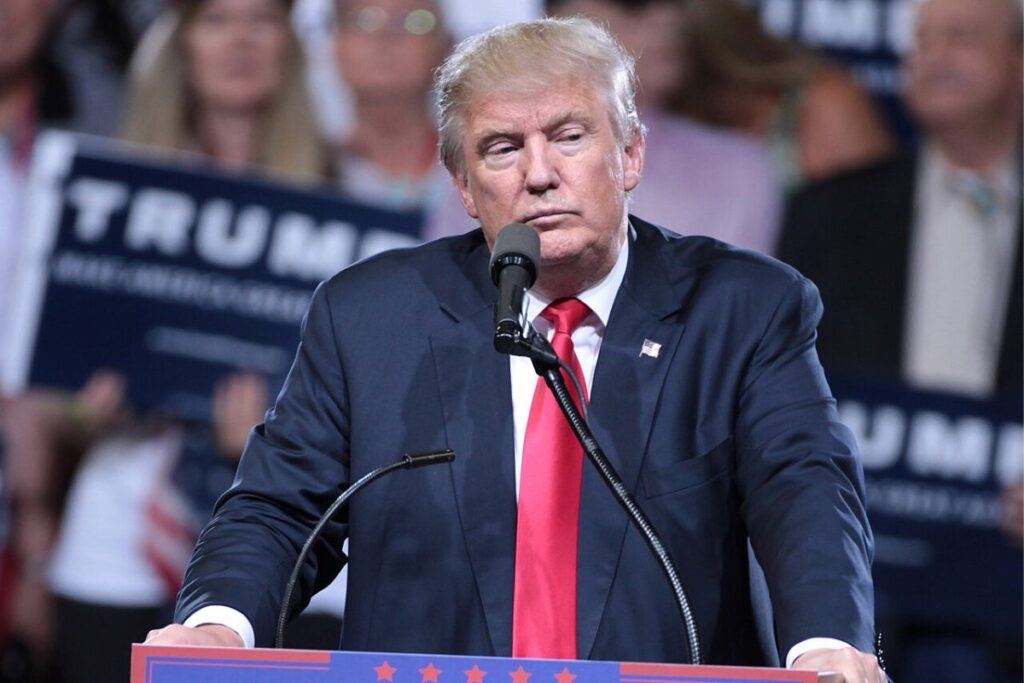
HAWTHORNE, California, October 9 — Former President Donald Trump purchased between $1 million and $5 million in SpaceX corporate bonds in November 2021, just days before the U.S. Space Force awarded the company a major national security launch contract, according to his 2021 financial disclosure filed with the Office of Government Ethics in May 2022. The bonds, issued by Space Exploration Technologies Corp., were acquired through a third-party financial intermediary and held as part of Trump’s personal investment portfolio.
The disclosure listed the holding under “Securities and Interests” as “SpaceX Corp. Bonds” with a value range of $1,000,001 to $5,000,000. No specific interest rate, maturity date, or exact purchase price was disclosed, as federal ethics reporting requires only value ranges.
On December 7, 2021, the Space Force announced a $1.2 billion award to SpaceX for five national security launches under the National Security Space Launch (NSSL) Phase 2 Lane 1 program. This was part of a broader $2.4 billion split with United Launch Alliance to ensure assured access to space for U.S. military payloads. The contract competed directly against ULA, a joint venture of Boeing and Lockheed Martin.
Trump was no longer in office at the time of the bond purchase, having left the presidency on January 20, 2021. As a private citizen, he was not subject to the same conflict-of-interest restrictions that apply to sitting federal officials.
The Office of Government Ethics reviewed the disclosure and found no violations of federal ethics laws. No evidence has been presented in public records or official investigations linking the bond purchase to the contract award, and no allegations of wrongdoing have been made by federal ethics officials or oversight bodies. The transaction reflects Trump’s broader pattern of investing in technology and innovation-driven companies, including prior disclosures of holdings in Amazon, Apple, and Google.
SpaceX, founded by Elon Musk in 2002 and headquartered in Hawthorne, California, has become a dominant player in both commercial and government launch services. Its Falcon 9 and Falcon Heavy rockets are frequently used by NASA, the Department of Defense, and commercial clients. The NSSL program remains a key component of U.S. national security space strategy, designed to ensure reliable launch capability for critical military and intelligence satellites.
No subsequent changes to Trump’s financial holdings in SpaceX have been reported in his annual disclosures through 2023. As of this writing, the intersection of private investment, aerospace industry growth, and federal contracting continues to draw attention amid increasing reliance on commercial space providers for national security missions.
Watch for future disclosures and any developments in the NSSL program’s next phase.