SYDNEY, October 10 — An international team of astronomers, led by Dr. Manisha Caleb and Dr. Themiya Nanayakkara from the University of Sydney, has made a groundbreaking discovery: a fast radio burst (FRB) designated FRB 20240304B. This extraordinary event originated in a young galaxy more than 10 billion years ago, with its radio signal traveling approximately 11 billion years to reach Earth—more than doubling the previous distance record for such events.
The James Webb Space Telescope was instrumental in pinpointing the host galaxy of the FRB, providing high-resolution infrared observations that allowed researchers to confirm its extreme distance and characterize the galactic environment. MeerKAT’s radio interferometry capabilities enabled the initial detection and localization of the burst, while Webb’s sensitivity to faint, distant objects provided critical follow-up data.
The discovery was announced through multiple scientific channels, including UC Santa Cruz, the W. M. Keck Observatory, NASA Science, Phys.org, EurekAlert!, and the South African Radio Astronomy Observatory, reflecting a collaborative effort across institutions.
The findings were also reported by Gagadget.com, Informat.ro, The News International, and Space.com. This detection offers new insights into the population and origins of fast radio bursts in the early universe, suggesting that such energetic phenomena can occur in young, distant galaxies.
The research contributes to understanding cosmic evolution and the distribution of matter in the universe over vast timescales. The team’s work highlights the power of combining radio and infrared observatories to probe the most energetic and distant transient events in the cosmos. Astronomers, a highly educated group of scientists who study astronomical objects, have primarily relied on observations to make their discoveries.
Today, the terms “astronomer” and “astrophysicist” are interchangeable, with professional astronomers typically holding a PhD in physics or astronomy and employed by research institutions or universities. The American Astronomical Society, which is the major organization of professional astronomers in North America, has approximately 8,200 members. The International Astronomical Union comprises about 12,700 members from 92 countries who are involved in astronomical research at the PhD level and beyond.
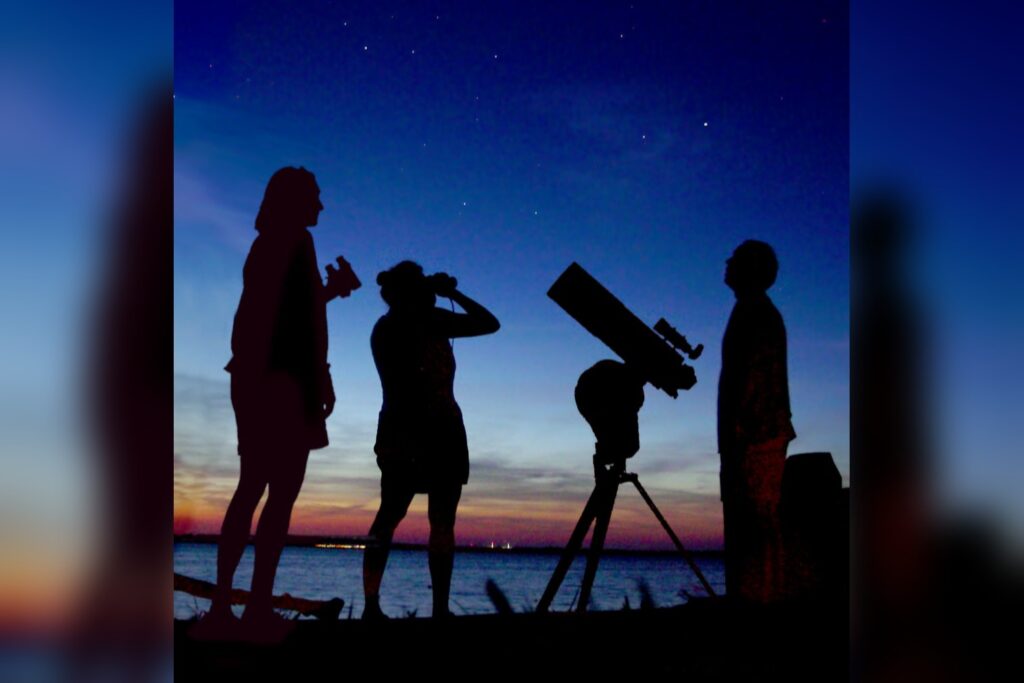
Contrary to the classical image of an old astronomer peering through a telescope through the dark hours of the night, it is far more common to use a charge-coupled device (CCD) camera to record a long, deep exposure, allowing a more sensitive image to be created because the light is added over time. Before CCDs, photographic plates were a common method of observation.
Modern astronomers spend relatively little time at telescopes, usually just a few weeks per year. Their research contributes to a better understanding of the universe and its origins, shedding light on the nature of matter, energy, and the evolution of celestial bodies. Looking forward, the team’s discovery opens up new avenues for research into the early universe, offering opportunities to learn more about the formation and evolution of galaxies, as well as the nature of fast radio bursts themselves.
As technology advances, it is expected that further discoveries will be made, expanding our knowledge and deepening our understanding of the cosmos. The James Webb Space Telescope, a powerful infrared observatory launched in December 2021, is a key tool in this research.
With its advanced capabilities, it is poised to make significant contributions to the field of astronomy and help us unravel the mysteries of the universe.